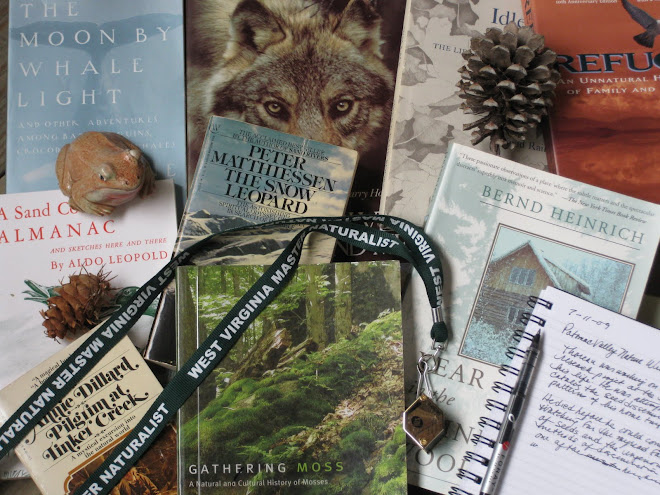
Our meeting on September 23 to discuss John Muir's My First Summer in the Sierra also included a quick vote for upcoming titles. The results:
October 2012: Roger Tory Peterson and Bill Thompson III, All Things Reconsidered (This is a collection of columns by Peterson published in Bird Watcher's Digest and selected by the publisher, Bill Thompson III.)
November 2012: Amy Minato, Siesta Lane
December 2012/January 2013: Henry Beston, Outermost House
February 2013: Edward Abbey, Desert Solitaire
March 2013: Gretel Erlich, The Solace of Open Spaces
Apri 2013: David Carroll, Swampwalker's Journal
May 2013: Tom Brown, Nature Observation and Tracking
Sunday, September 23, 2012

Monday, July 2, 2012
John Muir and My First Summer in the Sierra
When we try to pick out anything by itself, we find it hitched to everything else in the Universe.
-- My First Summer in the Sierra , 1911, page 110.
 Our Summer Read is John Muir's My First Summer in the Sierra. Muir needs no introduction here. As famous as he is, and as pervasive as quotes from his writings are, I suspect many people have never read those writings. My First Summer in the Sierra is one of his best. The text is available online at the magnificent tribute site compiled by the Sierra Club, which also includes photos, illustrations by Muir, biography and other resources. We will meet to discuss Muir and his superlative summer journal in September, date to be determined. Watch this site!

Sunday, May 20, 2012
Beatrix Potter: A Life In Nature

The critics weigh in:
Winner of the 2007 Lakeland Book of the Year Award
"Read Beatrix Potter by Linda Lear and you sense a woman poised between late-
Victorian constraint and the promises, intellectual and amorous, of liberation."
--Anthony Lane, The New Yorker
"Lear paints an appealing, revealing picture of an independent, accomplished and loving woman who used her art and research to educate herselve and a host of readers." Victorian constraint and the promises, intellectual and amorous, of liberation."
--Anthony Lane, The New Yorker
--Bookpage
"Lear is not only an impeccable historian but a grand storyteller...a magisterial and definitive biography, a delight in every way."
--The Horn Book
"As an appreciation of a life well-lived and a talent almost accidentally nurtured, Beatrix Potter, tells an absorbing story well worth reading."
--Christian Science Monitor
"Potter was a famously close observer of the world around her, and Lear is an equally close observer of her subject. The result is a meticulously researched and brilliantly re-created life that, despite its length and accretion of detail, is endlessly fascinating and often illuminating. It is altogether a remarkable achievement."
--Booklist, *Starred Review*
"In this remarkable biography...the author's meticulous attention to detail is obvious throughout, not to mention her elegant writing and exceptional scholarship. Highly recommended."
--Library Journal
"Potter's witty journals, with their close observations of people, animals, objects and places, serve as the basis for Lear's engrossing account, which will appeal to ecologists, historians, child lit buffs and those who want to know the real Squirrel Nutkin, Mrs. Tiggy-Winkle and Benjamin Bunny."
--Publishers Weekly
"The great achievement of this book is the way it knits together Potter's lifelong activities in art and science and shows how they are all part of an extraordinarily integrated life: how her feeling for plants and animals and her finely detailed observations of the natural world were the foundation stones of her children's books as well as her land management skills and environmental awareness."
--The Australian
"An in-depth biography of Beatrix Potter is long overdue and here Linda Lear fills that gap with a thoroughly well-researched and compelling book."
--Judy Taylor, author of Beatrix Potter: Artist, Storyteller and Countrywoman
Sunday, April 1, 2012
TINKERING WITH EDEN IN APRIL 2012
 Next up is Kim Todd's first book Tinkering with Eden, A Natural History of Exotics in America. Her other books are Chrysalis and Sparrow.
Todd's articles and essays have appeared in Orion, Sierra Magazine, California Wild and Grist, among other places. She has taught environmental and nature writing at the University of Montana, the University of California at Santa Cruz extension, and the Environmental Writers Institute. She currently teaches at Penn State, The Behrend College. Todd is a senior fellow with the Environmental Leadership Program.Todd has given talks at the Harvard Museum of Natural History, the New England Aquarium, the Getty Museum, the Commonwealth Club, Yale University, Bowdoin College, Wellesley College, the University of California (Davis), and many other venues. She has an M.F.A. in creative nonfiction and an M.S. in environmental studies, both from the University of Montana, and B.A. in English from Yale. The following information is from the author's website:
Tinkering with Eden is that rare thing, a profoundly important cautionary tale that is at the same time, both illuminating and entertaining."--William Kittredge, author of Nature of Generosity
Since Europeans started settling North America, exotic species have flooded in, becoming so prevalent that many Americans can't tell which species are native and which are not. Tinkering with Eden tells the stories of seventeen of these species, from the starling, introduced in 1890 by a man who wanted to bring all the birds mentioned in the plays of Shakespeare to New York's Central Park, to the gypsy moth, imported by a naturalist who was trying to breed a silk worm that would survive New England winters. The book details the disasters unleashed with many exotics, as well as the few success stories, like the Vedalia ladybug from Australia that saved the California citrus industry.
Reviews
The New York Times Book Review You really can't fool Mother Nature, as Kim Todd vividly shows in her fascinating, cautionary first book.
Booklist Imagine the common birds of city and suburb, the ones we all see daily as they perch on phone wires and peck for crumbs on the sidewalk. The three most numerous species in our imaginations—starlings, pigeons, and house sparrows—are all exotic, non-native birds that were deliberately introduced to North America from Europe. In this fascinating history of the introduction of exotic species, Todd gives the reader the story behind the initial introduction of each species as well as its status today.
The New Yorker The pigeons fluttering in public spaces, nutria in Southern swamps, gypsy moths across New England -- all these are the thriving, abundant relics of abandoned experiments, most of them well meant.
Grist Magazine Todd weaves 17 tales of past and present exotic organisms that have staked their claim in North American soils -- abetted, of course, by their human companions. With a healthy dose of sympathy for her human characters, Todd clarifies the complicated, wonky world of Exotic Pest Plant Councils and feral animal eradication.
Bookpage Tinkering with Eden -- a fascinating narrative enhanced by Todd's far-reaching research and rich story-telling abilities -- explores nature and humankind's relationship to it. A former newspaper reporter, the author has a fresh voice, an inquisitive mind and the instinct to ask questions about ordinary things the rest of us take for granted. Her book will interest any caring observer of our environment or lover of mystery.
On Earth—Magazine of the National Resources Defense Council Author Kim Todd has chosen a small selection of these stories to tell, each a short but richly detailed narrative of how and why a particular species has come to be considered American. Readers will get reacquainted with common pigeons (from France), honeybees (from England), and brown trout (from Germany). They'll also meet lesser-known transplants, like blood-sucking sea lampreys, colonies of monkeys, and orange-toothed nutrias.
Outside Magazine Reaching back to the original farmers, crackpots, and scientists who opened this biological Pandora's box, Todd uncovers a Greek tragedy of human heedlessness....[B]eautifully written natural history.
California Wild Todd eloquently explains how one man single-handedly brought European starlings to New York’s Central Park, why brown trout (Salmo trutta) arrived in 1883 as a generous gift from Germany, and how gypsy moths (Bombyx dispar) were imported into Massachusetts to try to jumpstart the country’s silk industry. In all cases, Todd weaves myth, fact, and humor into interesting stories that enlighten us about our everyday surroundings.
The Austin Chronicle Kim Todd's Tinkering With Eden provides a clear, objective harbinger of how much the introduction of exotic species in America has changed the landscape since Christopher Columbus first set foot this side of the Atlantic.
Discover Magazine Todd re-creates the all-too-often neglected human dramas— and sometimes farces— that attended the arrival of nearly a score of exotics, including Canadian mountain goats in Washington State, Chinese pheasants in Oregon, and the European gypsy moth in Massachusetts.
Click on Kim Todd's website link at top to read an excerpt. We meet on April 25 to discuss. Email pvnaturewriters@gmail for further information.
Monday, March 5, 2012
Bernd Heinrich is a Triple Hitter in March 2012
We devote March 2012 to our third selection by Bernd Heinrich: The Trees in My Forest. Here's what the publisher has to say:
Winner of the New England Book Award Best Nonfiction Award
Winner of the New England Book Award Best Nonfiction Award
and the Franklin Fairbanks Award of the Fairbanks Museum
In a book destined to become a classic,
In a book destined to become a classic,
biologist and acclaimed nature writer Bernd Heinrich takes readers
on an eye-opening journey through the hidden life of a forest.
CRITICAL PRAISE:
"He richly deserves the comparison to Thoreau." — Washington Post Book World
"He writes with a graceful lyricism....to attract many general readers of natural history." — Wall Street Journal
"He writes with a graceful lyricism...to attract many general readers of natural history." — Wall Street Journal
"Heinrich has neatly grafted art to his science giving us a lovely and intimate portrait of the Forest of Adam Hill." — James Prosek, author of Trout and Joe & Me
"In Heinrich's hands, the lives of trees are as noble and dramatic as the lives of men." — Washington Post
"The Trees in My Forest is a celebration of observation--an introduction to the mysteries and wonders before us." — Sue Bender, author of Plain and Simple and Everday Sacred
"The Trees in My Forest is a celebration of observation-an observation to the mysteries and wonders before us." — Sue Bender
"The Trees In My Forest is an engaging primer on the complex biological economics of the woods themselves...It's a quiet walk in stately woods...In Heinrich's hands, the lives of trees are as noble and as dramatic as the lives of men." — The Washington Post
"These passionate observations of a place 'where the subtle matters and the spectacular distracts' superbly mix memoir and science." — New York Times
"These passionate observations of a place where the subtle matters and the spectacular distracts superbly mix memoir and science." — New York Times
We meet to discuss this book on Sunday, March 25, at a member's home. Email pvnaturewriters@gmail for further information.
Saturday, January 28, 2012
ARCTIC DREAMS DISCUSSION POSTPONED
Our discussion of Arctic Dreams is postponed until the February 2012 meeting. Date, time place TBA This work has so much material that we need 3 months to do it justice! . Our January meeting was devoted to group business and selection of books for the coming season. See left for the winning works that we will be reading in 2012!
Sunday, December 11, 2011
We Dream of the Arctic in December 2011
 As our globe warms, the Arctic as we once knew it is fast becoming a dream of time past. This month I'm thrilled to announce that we delve into Arctic Dreams as delivered by the prolific and much honored author Barry Lopez. Arctic Dreams won the 1986 National Book Award and is considered his masterpiece.
From the publisher: "Lopez offers a thorough examination of this obscure world-its terrain, its wildlife, its history of Eskimo natives and intrepid explorers who have arrived on their icy shores. But what turns this marvelous work of natural history into a breathtaking study of profound originality is his unique meditation on how the landscape can shape our imagination, desires, and dreams. Its prose as hauntingly pure as the land it describes, Arctic Dreams is nothing less than an indelible classic of modern literature."
Bill Moyer's Interview with Barry Lopez: http://www.pbs.org/moyers/journal/04302010/profile.html
Review excerpts : "Jubilant....Barry Lopez lavishes his discoveries into a portfolio of delights." The New York Times Book Review "Wonderfully informed and evocative....Keen observation given shape with language that is deft and vivid." Chicago Tribune "Rich, abundant, vigorously composed." The Boston Globe "[It is the earth's] synchronous wealth of life — of all life — that Barry Lopez is celebrating in his jubilant new book. Among contemporary nature writers Mr. Lopez is especially a rhapsodist, and what he has done in this passionate paean to the Arctic and its cycles of light and darkness, its species of ice, its creatures and waters, is to present a whole series of raptures and riffs on the subject of musk oxen, ivory gulls, white foxes, polar bears, icebergs and sea currents..." New York Times Book Review
Author website: http://www.barrylopez.com/blog.htm
Reviews:
http://www.guardian.co.uk/books/2005/apr/02/featuresreviews.guardianreview35
http://www.powells.com/biblio/2-9780375727481-6
NOAA Arctic site: http://www.arctic.noaa.gov/detect/
We meet in January to share our impressions. Stay tuned for time and place.
Subscribe to:
Posts (Atom)