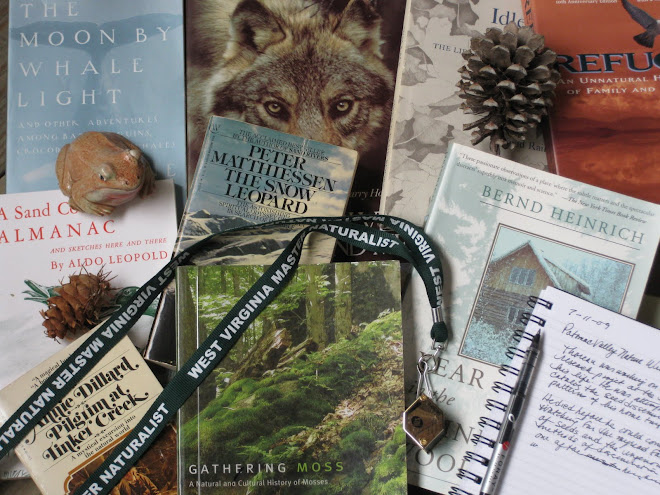
Monday, January 4, 2010

BERND HEINRICH AUTHOR FOR JANUARY 2010

At our February 7, 2010 meeting (CANCELLED DUE TO BLIZZARD OF 2010) we will discuss Bernd Heinrich's Winter World. Biologist Heinrich is the author of numerous award-winning books, including the bestselling Winter World, Mind of the Raven, and Why We Run, (he has also had a career as a top long distance runner) and has received countless honors for his scientific work. His most recent published book is Summer World. He studied at the University of Maine and UCLA, and is professor emeritus of biology at the University of Vermont. He divides his time between Vermont and the forests of western Maine.

Click here to read New York Times article SCIENTIST AT WORK: BERND HEINRICH; Signs of Survival In a Frozen Forest by James Gorman, from January 7, 2003. Click photo of book cover at right to see inside WINTER WORLD.

PVNWG Celebrates One Year of Meetings!

On a sharply chilly January 3, 2010 we marked twelve months of Reader's Club meetings and warmed to a brand new year of great reads and fresh insights.

The six members present (including one new--welcome!) gave Diane Ackerman's The Moon by Whale Light a thorough going over. This book is actually more like 4 books in one--it combines four lengthy essays on different groups of animals: bats, crocodilians, whales, and penguins.

We all praised Ms. Ackerman's skills in acute observation, bell-like clarity of expression, the breath-taking figurative language for which she is so well known, and her sense of humor. We also noted that her focus in this particular book included not only incredible detail regarding the natural history of the creatures being studied by the researchers whom she interviews and accompanies, but also on the very human natures of the researchers themselves. Some liked this facet of the book, others felt it was a distraction.

Although the essays were not originally written to be published together, we did detect a theme of human misconceptions about animals and the ensuing harm humans have caused to them. For example, bats being feared as evil, rabies-carrying, bloodsucking creatures of the night, attacking humans and getting tangled in hair--when actually they are highly important contributors to our planetary ecosystem, one of the least likely of critters to convey rabies to humans, are major pollinators, consumers of harmful insects, attentive parents, and all around remarkable and fascinating mammals. Sorely misunderstood in previous years, bat populations have been decimated severely by human actions, intentionally, and more passively, by loss of habitat. Bats colonies are also dying out due to a disease. To promote bat conservation, including installing bat houses go to http://www.batcon.org/

A related theme was how much we owe to dedicated researchers such as the ones profiled in the book--but also the vast amount there is to yet to learn. A whale researcher in the book remarks that "once people learn about [an animal] their indifference, which is always based on ignorance, will be replaced with fascination, which is based on knowledge." Questions about the very concept of intelligence and its expression in animals and in humans is woven through the warp of Ackerman's descriptions. The whale researcher again: "What we call intelligence may only be a kind of vandalism, just mischief on a grand scale. It might not be the only form mind can take, and it might have little to do with real wisdom. " Something to mull over next time you are sitting in commuter traffic.

Read this book and you will be astonished at what you learn about bats, crocs, whales and penguins. It has inspired us to learn more about these creatures, especially about our native species of bats. This is also a great read for those interested in exploring the historical relationship between humans and animals, and perhaps, for nurturing hope for the future.

Tuesday, December 29, 2009

JANUARY 3, 2010 MEETING REMINDER


The next PVNWG Reader's Club meeting is set for this coming Sunday, January 3, 2010 at 3:00 PM. We again will be meeting at a member's private home by her gracious invitation. If you have not yet attended a meeting, but would like to join us, you may attend as a current member's guest. Email pvnaturewriters@gmail.com to express your interest and we will make the necessary arrangements. Previous attendees should have received directions by email. With our January meeting we celebrate our first year of monthly meetings and look forward to reading more wonderful authors in 2010!

Sunday, December 6, 2009

DIANE ACKERMAN AUTHOR FOR DECEMBER


For December our primary reading selection is Diane Ackerman's The Moon By Whale Light, a collection of essays on her encounters with rare and endangered species, as she accompanied researchers seeking to understand and protect them. Members may read any of her works but note that some of her works are more focused on natural history than others.

From her website:
Poet, essayist, and naturalist, Diane Ackerman is the author of two dozen highly acclaimed works of nonfiction and poetry, including A Natural History of the Senses -- a book beloved by millions of readers all over the world. Humans might luxuriate in the idea of being “in” nature, but Ms. Ackerman has taught generations that we are nature—for “no facet of nature is as unlikely as we, the tiny bipeds with the giant dreams.” In prose so rich and evocative that one can feel the earth turning beneath one’s feet as one reads, Ackerman’s thrilling observations—of things ranging from the cloud glories to the human brain to endangered whooping cranes—urge us to live in the moment, to wake up to nature’s everyday miracles.


Ms. Ackerman has received a D. Lit. from Kenyon College, Guggenheim Fellowship, Orion Book Award, John Burroughs Nature Award, and the Lavan Poetry Prize, as well as being honored as a Literary Lion by the New York Public Library. She also has the rare distinction of having a molecule named after her --dianeackerone. She has taught at a number of universities, including Columbia and Cornell. Her essays about nature and human nature have been appearing for decades in The New York Times, Smithsonian, Parade, The New Yorker, National Geographic and many other journals, where they have been the subject of much praise.


To learn more, click on Ms. Ackerman's photo above to visit her webpage.

REPORT DECEMBER 6 MEETING

A chilly December afternoon. Bright remnants of yesterday's snowfall. Water glinting through bare trees. Five nature lovers convene to talk about Wendell Berry's The Long Legged House and the ideas therein. And eat cookies and drink wassail.

Berry's writing is deep and wide like the Kentucky river where he has made his home. Diverse topics and personal stories flow like ripples and currents joining together in one major theme: our relationship with nature, what it has become, but also what it can be, once was, could be again. Published in 1965, the book is a collection of Berry's earliest essays and is jampacked with insights and ideas ---ideas that are more timely and urgent than ever. All the more shocking that none of us seemed able to find the book in our local libraries! So with purchased copies in hand, we shared passages that we found exceptional such as:


The great increase of our powers is itself maybe the most immediate cause of our
loss of vision. It must be a sort of natural law that any increase in man's
strength must involve a lengthening of his shadow; as we grow in power, we are
pursued by an ever growing darkness.

Berry describes our collective errors with an eloquent, slap-in-the-face accuracy. But he balances that bitter medicine with a balm to the spirit, a prescription for salvation for himself and for us:


And so, difficult and troubling as the times are, I must not neglect to say
that even now I experience hours when I am deeply happy and content, and
hours where I feel the possibility of greater happiness and contentment than
I have yet known. These times come to me when I am in the woods, or at work
on my little farm. They come bearing the knowledge that the events of man
are not the great events; that the rising of the sun and the falling of the
rain are more stupendous than all the works of the scientists and the
prophets; that man is more blessed and graced by his days than he can ever
hope to know; that the wildflowers silently bloom in the woods, exquisitely
shaped and scented and colored, whether any man sees and praises them or
not. A music attends the things of the earth. To sense that music is to be
near the possibility of health and joy.


Not to be outdone by Berry, we all agreed on the importance of balancing literary "calls" to responsiblity and stewardship with a straightforward celebration of the endless beauty and fascination of nature. Our line up of primary reading selections for the early months of 2010 are as follows:

January 2010 Bernd Heinrich: Winter World
February 2010 Mary Oliver: Owls and Other Fantasies
March 2010 E.O. Wilson: Naturalist (his autobiography)
April 2010 Barbara Kingsolver: Small Wonders

(NOTE: Each month's book will be discussed at the meeting held on the FIRST SUNDAY of the following month. Example, January's book selection Winter World will be the topic of discussion at the February meeting.)

Cheers to the Readers' Club members and all the great authors we have enjoyed in 2009. Our January 2010 meeting will cap off our first year of monthly get togethers!

Wednesday, December 2, 2009

SEE YOU AT DEC 6 MEETING!

The PVNWG Reader's Club is set to meet on Sunday, December 6 at 3:00 PM. We will discuss our thoughts about Wendell Berry's The Long Legged House.

New members always welcome! Since our meeting is at a private home, new members can attend as a guest of a current members. If you are a person interested in joining us, please email pvnaturewriters@gmail.com to make arrangements.

If you have previously attended a meeting, email a query for directions to the location.

Hope to see you there!

Saturday, November 7, 2009

WENDELL BERRY IS AUTHOR FOR NOVEMBER 2009


The PVNWG Readers' Club has selected Wendell Berry as the author and The Long-Legged House as our read for the month of November 2009. The book will be the focus of the Readers' Club meeting on December 6.
Wendell Berry farmed a homestead in Northern Kentucky from the early 1960s, and is one of the most revered environmental writers, winning numerous awards. His body of work includes novels, short stories, essays, fiction and poetry. The Long-Legged House, published in 1969, was his first collection of essays and set forth his dominant themes: sustainable agriculture, connection to place, the pleasures of good food, good work, healthy communities, fidelity, reverence, and the interconnectedness of all life.


All About the Author


Reviews


An Interview with Wendell Berry

"The Requirement" by Wendell Berry (Harper's Magazine)