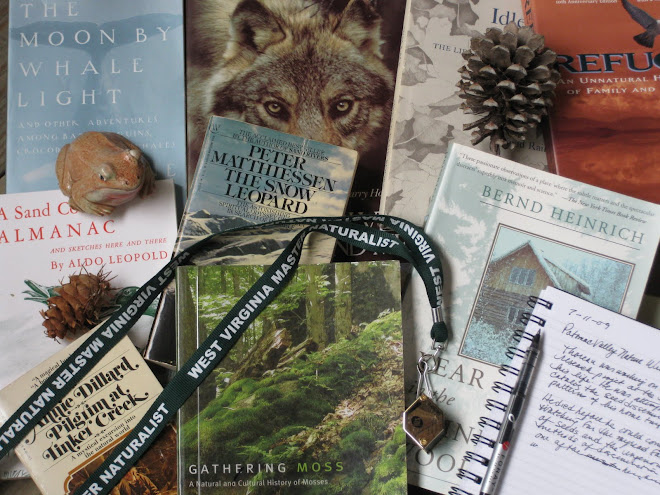
I've been noticing how multidimensional Wallace's work in Idle Weeds is. Check out the description of the nature writing class that he teaches:
The Four Dimensions of Nature Writing: Fall 2008
This course will explore our nature writing tradition with readings, field trips, and writing exercises. We will approach the tradition through four dimensions wherein we perceive nature: the self, the "other," space, and time. We will read representative excerpts from founding figures: Gilbert White -- nature as the self; William Bartram -- nature as the "other"; Henry Thoreau -- nature as space; Charles Darwin -- nature as time. This course will explore attempts to coordinate the dimensions with things like Bigfoot legends in The Klamath Knot: Explorations in Myth and Evolution. Field trips and writing exercises will focus on interpreting local landscapes in terms of the four dimensions.
Friday, May 29, 2009

Some Talent!
I'm found this month's book a little slow going at first, but the more I read, the more admiring I've become of the author's talent with extendedmetaphors--like comparing the ridge's canopy seen from above to the ocean, with birds and insects leaping up like porpoises-- and suggesting that the insects thriving together on milkweed plants are like a Borgia court thriving on poison!
The way he uses all his senses is staggering, incredible powers of observation. He is especially skillful with sound and color. He makes all kinds of allusions to art and history. He writes about his experiences of time morphing and feeling the presence of ghosts of past human inhabitants. I'm writing down so many snippets of his writing in my journal. The book has so many levels I am in awe of his accomplishment. I try to imagine how he wrote the book, how many hours did he spend sitting alone on the ridge, staying present with what was occurring around and within him? Looking forward to our discussion! Sandy
The way he uses all his senses is staggering, incredible powers of observation. He is especially skillful with sound and color. He makes all kinds of allusions to art and history. He writes about his experiences of time morphing and feeling the presence of ghosts of past human inhabitants. I'm writing down so many snippets of his writing in my journal. The book has so many levels I am in awe of his accomplishment. I try to imagine how he wrote the book, how many hours did he spend sitting alone on the ridge, staying present with what was occurring around and within him? Looking forward to our discussion! Sandy
Saturday, May 23, 2009
Idle Weeds Starring Short Tailed Shrew
Click photo for more info and images. Photo by Phil Myers, Museum of Zoology, University of Michigan , Creative Commons License
May Meeting at Yankauer Preserve!
This month's Potomac Valley Nature Writing Group meeting will take place Sunday, May 31, 3:00 PM in the pavilion at Yankauer Nature Preserve. Please bring a lawn chair and water. During the summer months we will plan to meet at different locations outdoors, and return to our Shepherd University classroom in the fall.
The book for May is Idle Weeds: Life of a Sandstone Ridge by David Rains Wallace. Members are encouraged to share one or two passages in the book they found especially notable and why. We also like to hear readings of members' own writings, especially when inspired by the current book of the month.
After our discussion, those who wish can explore the trails and possibly do some nature journaling. New members are welcome! Don't worry if you haven't read the book. For directions to the Yankauer Preserve, go to http://www.potomacaudubon.org/yankauer.html
Hope to see you!
Monday, April 27, 2009
DAVID RAINS WALLACE is AUTHOR FOR MAY
David Rains Wallace needs a publicist! He has written many natural history books and is highly regarded as a naturalist and author, but finding information about him on the web is very difficult. See the few links at left I was able to locate. Please post if you have information to share. We are reading Idle Weeds: The Life of an Ohio Sandstone Ridge for May.
Sunday, April 26, 2009
REPORT ON APRIL MEETING
This afternoon we had a scintillating discussion of Terry Tempest Williams' REFUGE. The book generated ideas and questions on a wide range of topics. The book received mixed reviews but all agreed it was a worthwhile read. We had two new members attending, welcome!
Next meeting was set for May 31 at 3:00 PM with a possible change of location. Confirmation on location to come. In general, we will be scheduling meetings for the last Sunday of the month.
We were also very productive in that we have set books of the month through October! Participating members each suggested one title then they were drawn in random order.
MAY: Wallace, David Rains: Idle Weeds – The life of an Ohio Sandstone Ridge
JUNE Borland, Hal; Beyond Your Doorstep
JULY Costanz, George: Hollows, Peepers & Highlanders: An Appalachian Mountain Ecology
AUGUST Kline, David: Scratching the Woodcock--Nature on an Amish Farm
SEPTEMBER Kimmerer, Robin Wall: Gathering Moss: A Natural and Cultural History of Mosses, 2003
OCTOBER Winn, Marie: Red-Tails in Love: A Wildlife Drama in Central Park, 1998
Click each title above to be linked to a website with more information!
I'm realizing that while the selection of a specific book is important, it is not as important as the responses we each have as we read, and then the special chemistry that occurs when we all get together and share our insights.
Happy reading (and writing! ;-)
Monday, March 30, 2009
Terry Tempest Williams' REFUGE


In REFUGE: An Unnatural History of Family and Place, Terry Tempest Williams witnesses the diminishment of the migratory bird refuge at Great Salt Lake, walks with a loved one through illness and grief, and explores the meaning of her family history. A dominant theme of the book is accepting loss and embracing change as part of nature.
The author is celebrated for her unique style and ability to evoke a deep emotional response in the reader. In 2006, Ms. Williams received the Robert Marshall Award from The Wilderness Society, their highest honor given to an American citizen. She also received the Distinguished Achievement Award from the Western American Literature Association and the Wallace Stegner Award given by The Center for the American West. She is the recipient of a Lannan Literary Fellowship and a John Simon Guggenheim Fellowship in creative nonfiction. Terry Tempest Williams is currently the Annie Clark Tanner Scholar in Environmental Humanities at the University of Utah.
Subscribe to:
Posts (Atom)