Tuesday, July 28, 2009

JOURNALING CHALLENGE FOR AUGUST!


Four members were present at our July meeting. We enjoyed a sudden thunderstorm, which soon was replaced by fluffy clouds and a pleasant breeze. Joe Pye Weed and Purple Coneflowers grew tall beside the pavilion.
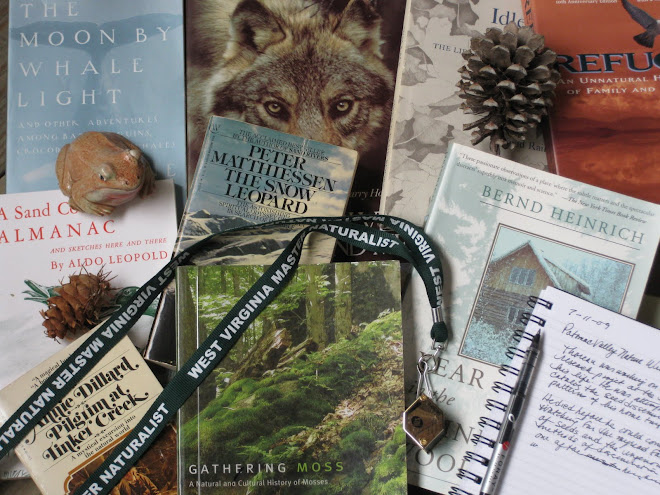
While we all had praise for Hollows, Peepers and Highlanders, -(the chapter on cannibalistic fireflies made a special impression)- we noted a trend of monotony in the style and content of the list of books we have been reading.
Therefore, as a group we will not be reading Scratching the Woodchuck for August. To become more in line with the "nature writing" part of our group's name, our challenge for the coming month is for each of us to make one entry in our nature journals each day! The entry can be very short, even a phrase, but should relate somehow to our personal relationship with nature--thoughts, feelings, sensory experiences, facts learned. Nature as broadly defined. Journal entries will be shared at the next meeting on August 30, 3PM at Yankauer. It will be fun to see the themes that run through each member's entries.
Each member is asked to bring a short excerpt from any author's work that provides inspiration for her/himself to write about nature.
Plans are in the works for a possible nature writing/journaling "retreat" for autumn. Stay tuned.
Please email Sandy at pvnaturewriters@gmail.com with any comments or suggestions.

Monday, June 29, 2009

HOLLOWS PEEPERS AND HIGHLANDERS FOR JULY


July's reading selection takes us home with Hollows, Peepers, and Highlanders: An Appalachian Mountain Ecology by George Constantz. (PVNWG recommends the revised and expanded edition published by West Virginia University Press in 2004.) The book first paints a broad picture to give the reader an understanding of the geologic origins of the region. Combining scientific insights with first hand experiences, Constantz entertainingly describes the adaptations of the species that live there. He puts it all together in a final section on climate and changes through the seasons.
Naturalist George Constantz was born in Washington, DC but spent part of his childhood in Mexico and Colombia. With degrees in biology and zoology, he has worked as a teacher, ecologist, researcher and writer. Active in efforts to conserve water quality in West Virginia, he founded the nonprofit Cacapon Institute and manages the Education program at Canaan Valley Institute. He and his wife, Nancy Ailes, live in the Cacapon River watershed. See author and book related links at left. (Photo Credit: Ken Thomas, Wikimedia Commons)

Report on June 2009 Meeting

It was a cool, overcast Sunday, June 28 at Yankauer Nature Preserve. Drops of rain echoed on the metal roof of the pavilion as we watched and listened to birds in the surrounding trees and undergrowth. Along the path, Scarlet Bee Balm was in full bloom. In this pleasant setting, four of us kicked off summer with a discussion inspired by Beyond Your Doorstep by Hal Borland. We reviewed author candidates for future months, including some poets! Having read several works from decades ago, we decided to move toward more contemporary writers and include works by or about inspiring environmentalists. Check the reading list for updates!

Sunday, June 28, 2009

Backup Site for PVNWG Meeting

We should be fine today at the Yankauer Pavilion even if it rains. But in case of winds or bad storm we can adjourn to Shaharazade's Tea Room in Shepherdstown. They are open through the late afternoon, unlike some of the other places in Shetown. The website makes it look wild but everytime I've been there its been peaceful and quiet. See map:
http://www.shaharazades.com/directions.htm

Wednesday, June 24, 2009

Reminder June PVNWG Meeting

This month's meeting is rapidly approaching! Join us at Yankauer Nature Preserve at 3:00 PM, Sunday June 28. Bring water and a camp or lawn chair. We'll be discussing Hal Borland's Beyond Your Doorstep. But topics take off from there, so don't stay away if you haven't read the book. Directions to the preserve: http://www.potomacaudubon.org/yankauer.html#dir
New members are welcome! Bring any books you would like to suggest for our reading list.

Wednesday, June 3, 2009

Good benefits

"Thanks to PVNWG I am getting exposed to so many good writers and it is broadening my view of nature from field guides to personal guides, from listing to listening, from recording to observing. This is fun!"
Cheryl

Monday, June 1, 2009

HAL BORLAND IS AUTHOR FOR JUNE 2009

June's book selection is Beyond Your Doorstep: A Handbook to the Country by Hal Borland. Borland is well known as the contributor of 1, 750 nature essays that appeared in the Sunday edition of the New York Times between 1942 and 1978. He was also the author of many other nonfiction and fiction works, including the memoir The Dog Who Came to Stay, and the novel When Legends Die, which was adapted into a film in the early 70s.
He and his wife, Barbara Dodge Borland, who was also a writer, lived on a 100 year old farm in the far northwest corner of Connecticut, at the edge of the Berkshires. He and Barbara moved to the farm after he had a life-changing encounter with a serious illness. Their land included one side of a mountain and fronted the Housatonic River. Borland cherished his farm as a "home at the end of nowhere," with an unmarked mailbox. There is a room devoted to Borland at the Audubon Center in Sharon, CT. There visitors can view mementos and objects from his small second floor study, including his manual typewriter. (See author links at left for photos.)
Borland writes in an easy, accessible style. Reading his work you often feel as if you have received an intimate letter from a close friend. Beyond Your Doorstep is considered a classic of nature writing. The book's backcover describes it -- "A stylishly well written guide to, and meditation on, the flora and fauna of the countryside, Beyond Your Doorstep is now more timely than ever as a source of inspiration for anyone with a desire to know more about the living things we so often look at but never actually see or understand. "
Borland tells us his book is, "primarily about the countryside, not the wilderness; countrysides are common and within reach of almost everyone."

First Chapter: The Country House. "The newcomer to the country will find the first signs of "wild life" in his own house. Even before he explores the dooryard he can sharpen his eyes indoors. He may be surprised at the outsiders who want to share that house with him."