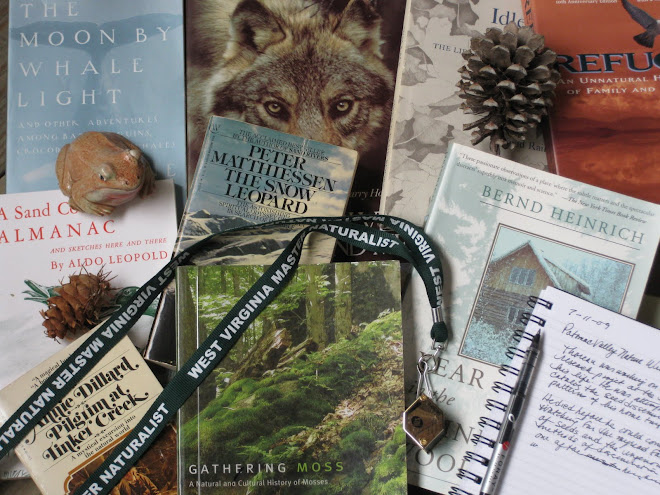
"Thanks to PVNWG I am getting exposed to so many good writers and it is broadening my view of nature from field guides to personal guides, from listing to listening, from recording to observing. This is fun!"
Cheryl
Wednesday, June 3, 2009

Monday, June 1, 2009
HAL BORLAND IS AUTHOR FOR JUNE 2009
June's book selection is Beyond Your Doorstep: A Handbook to the Country by Hal Borland. Borland is well known as the contributor of 1, 750 nature essays that appeared in the Sunday edition of the New York Times between 1942 and 1978. He was also the author of many other nonfiction and fiction works, including the memoir The Dog Who Came to Stay, and the novel When Legends Die, which was adapted into a film in the early 70s.
He and his wife, Barbara Dodge Borland, who was also a writer, lived on a 100 year old farm in the far northwest corner of Connecticut, at the edge of the Berkshires. He and Barbara moved to the farm after he had a life-changing encounter with a serious illness. Their land included one side of a mountain and fronted the Housatonic River. Borland cherished his farm as a "home at the end of nowhere," with an unmarked mailbox. There is a room devoted to Borland at the Audubon Center in Sharon, CT. There visitors can view mementos and objects from his small second floor study, including his manual typewriter. (See author links at left for photos.)
Borland writes in an easy, accessible style. Reading his work you often feel as if you have received an intimate letter from a close friend. Beyond Your Doorstep is considered a classic of nature writing. The book's backcover describes it -- "A stylishly well written guide to, and meditation on, the flora and fauna of the countryside, Beyond Your Doorstep is now more timely than ever as a source of inspiration for anyone with a desire to know more about the living things we so often look at but never actually see or understand. "
Borland tells us his book is, "primarily about the countryside, not the wilderness; countrysides are common and within reach of almost everyone."
He and his wife, Barbara Dodge Borland, who was also a writer, lived on a 100 year old farm in the far northwest corner of Connecticut, at the edge of the Berkshires. He and Barbara moved to the farm after he had a life-changing encounter with a serious illness. Their land included one side of a mountain and fronted the Housatonic River. Borland cherished his farm as a "home at the end of nowhere," with an unmarked mailbox. There is a room devoted to Borland at the Audubon Center in Sharon, CT. There visitors can view mementos and objects from his small second floor study, including his manual typewriter. (See author links at left for photos.)
Borland writes in an easy, accessible style. Reading his work you often feel as if you have received an intimate letter from a close friend. Beyond Your Doorstep is considered a classic of nature writing. The book's backcover describes it -- "A stylishly well written guide to, and meditation on, the flora and fauna of the countryside, Beyond Your Doorstep is now more timely than ever as a source of inspiration for anyone with a desire to know more about the living things we so often look at but never actually see or understand. "
Borland tells us his book is, "primarily about the countryside, not the wilderness; countrysides are common and within reach of almost everyone."
First Chapter: The Country House. "The newcomer to the country will find the first signs of "wild life" in his own house. Even before he explores the dooryard he can sharpen his eyes indoors. He may be surprised at the outsiders who want to share that house with him."
REPORT ON MAY MEETING
Our meeting on May 31 was held at the outdoor pavilion at Yankauer Nature Preserve. Six members were present. The beautiful weather and natural surroundings must have spurred our creativity. Inspired by our May book selection, we had one our most thought-provoking dicussions yet. I just filled almost eight pages in my journal trying to capture the many ideas and questions that members tossed around like hot potatoes.
A sampling: Do animals have emotions? What about insects? Are humans part of nature? If we are different from the rest of nature, how? Why is writing and reading about nature important? Can new technology help us reverse damage to the ecosystem? What else needs to happen? Are animals much smarter than we know? The ethics of cowbirds. Tool kit making chimps. Do animals watch people like we watch animals?
We missed those of you who couldn't make it!
Watch the blogspot for info about June's book selection, Hal Borland's Beyond My Doorstep. The next meeting is scheduled for 3:00 PM, Sunday, June 28, again at Yankauer. But check the blogspot closer to the date for any changes. We will be arranging a back up location in the event of rain. New members always welcome.
A sampling: Do animals have emotions? What about insects? Are humans part of nature? If we are different from the rest of nature, how? Why is writing and reading about nature important? Can new technology help us reverse damage to the ecosystem? What else needs to happen? Are animals much smarter than we know? The ethics of cowbirds. Tool kit making chimps. Do animals watch people like we watch animals?
We missed those of you who couldn't make it!
Watch the blogspot for info about June's book selection, Hal Borland's Beyond My Doorstep. The next meeting is scheduled for 3:00 PM, Sunday, June 28, again at Yankauer. But check the blogspot closer to the date for any changes. We will be arranging a back up location in the event of rain. New members always welcome.
Friday, May 29, 2009
The Four Dimensions
I've been noticing how multidimensional Wallace's work in Idle Weeds is. Check out the description of the nature writing class that he teaches:
The Four Dimensions of Nature Writing: Fall 2008
This course will explore our nature writing tradition with readings, field trips, and writing exercises. We will approach the tradition through four dimensions wherein we perceive nature: the self, the "other," space, and time. We will read representative excerpts from founding figures: Gilbert White -- nature as the self; William Bartram -- nature as the "other"; Henry Thoreau -- nature as space; Charles Darwin -- nature as time. This course will explore attempts to coordinate the dimensions with things like Bigfoot legends in The Klamath Knot: Explorations in Myth and Evolution. Field trips and writing exercises will focus on interpreting local landscapes in terms of the four dimensions.
The Four Dimensions of Nature Writing: Fall 2008
This course will explore our nature writing tradition with readings, field trips, and writing exercises. We will approach the tradition through four dimensions wherein we perceive nature: the self, the "other," space, and time. We will read representative excerpts from founding figures: Gilbert White -- nature as the self; William Bartram -- nature as the "other"; Henry Thoreau -- nature as space; Charles Darwin -- nature as time. This course will explore attempts to coordinate the dimensions with things like Bigfoot legends in The Klamath Knot: Explorations in Myth and Evolution. Field trips and writing exercises will focus on interpreting local landscapes in terms of the four dimensions.
Some Talent!
I'm found this month's book a little slow going at first, but the more I read, the more admiring I've become of the author's talent with extendedmetaphors--like comparing the ridge's canopy seen from above to the ocean, with birds and insects leaping up like porpoises-- and suggesting that the insects thriving together on milkweed plants are like a Borgia court thriving on poison!
The way he uses all his senses is staggering, incredible powers of observation. He is especially skillful with sound and color. He makes all kinds of allusions to art and history. He writes about his experiences of time morphing and feeling the presence of ghosts of past human inhabitants. I'm writing down so many snippets of his writing in my journal. The book has so many levels I am in awe of his accomplishment. I try to imagine how he wrote the book, how many hours did he spend sitting alone on the ridge, staying present with what was occurring around and within him? Looking forward to our discussion! Sandy
The way he uses all his senses is staggering, incredible powers of observation. He is especially skillful with sound and color. He makes all kinds of allusions to art and history. He writes about his experiences of time morphing and feeling the presence of ghosts of past human inhabitants. I'm writing down so many snippets of his writing in my journal. The book has so many levels I am in awe of his accomplishment. I try to imagine how he wrote the book, how many hours did he spend sitting alone on the ridge, staying present with what was occurring around and within him? Looking forward to our discussion! Sandy
Saturday, May 23, 2009
Idle Weeds Starring Short Tailed Shrew
Click photo for more info and images. Photo by Phil Myers, Museum of Zoology, University of Michigan , Creative Commons License
, Creative Commons License
May Meeting at Yankauer Preserve!
This month's Potomac Valley Nature Writing Group meeting will take place Sunday, May 31, 3:00 PM in the pavilion at Yankauer Nature Preserve. Please bring a lawn chair and water. During the summer months we will plan to meet at different locations outdoors, and return to our Shepherd University classroom in the fall.
The book for May is Idle Weeds: Life of a Sandstone Ridge by David Rains Wallace. Members are encouraged to share one or two passages in the book they found especially notable and why. We also like to hear readings of members' own writings, especially when inspired by the current book of the month.
After our discussion, those who wish can explore the trails and possibly do some nature journaling. New members are welcome! Don't worry if you haven't read the book. For directions to the Yankauer Preserve, go to http://www.potomacaudubon.org/yankauer.html
Hope to see you!
The book for May is Idle Weeds: Life of a Sandstone Ridge by David Rains Wallace. Members are encouraged to share one or two passages in the book they found especially notable and why. We also like to hear readings of members' own writings, especially when inspired by the current book of the month.
After our discussion, those who wish can explore the trails and possibly do some nature journaling. New members are welcome! Don't worry if you haven't read the book. For directions to the Yankauer Preserve, go to http://www.potomacaudubon.org/yankauer.html
Hope to see you!
Subscribe to:
Posts (Atom)